Wednesday, September 29, 2010

Living Hamlet

My sweet, auburn-haired, four-year-old niece, Emma Catherine Grace Thompson, was sexually abused and beaten to death two summers ago. You probably read about this tragic story in the Houston Chronicle or saw a report about it on one of the local television news networks at the time of its occurrence and again this past summer when Emma’s mother, Abigail Young, was tried and convicted of reckless and serious bodily injury to a child by omission. A jury found her boyfriend, Lucas Coe, guilty of super aggravated sexual assault of a child just last week. Needless to say, it has been a cathartic and emotionally draining experience for my whole family. We found precious little comfort in the convictions of the perpetrators of this heinous crime; it was truly a pyrrhic victory at best, for what could gratify the heart other than the return of that adorable child in the flesh? And for that, we must impatiently wait until the Day of Judgment.
 
For the most part, I have successfully contained the seething rage lurking in the dark corridors of my heart, but Shakespeare summoned it forth these last few weeks when I revisited Hamlet with my AP English IV class at St. Thomas. The bard’s tale of the brooding, philosophical hero hell bent on revenge profoundly moved me, stirring something long dormant in one of the subterranean rooms of my soul. I can truly say with a greater degree of certainty than ever before that I not only understand Hamlet’s maniacal desire for vengeance, but I absolutely empathize with him. I observed firsthand the deleterious effects that a calm, collected, and unyielding rage can wreak upon the human psyche. Frankly, it’s enough to terrorize the soul because it is to stare into the abyss. Those famous soliloquies were no longer merely poetical speeches but ineffable ponderings of a kindred soul whose heart and mind were so similar to my own. There was a very real temptation among many of the men of my family to act upon our baser instincts for revenge, like Hamlet, rather than letting the justice system mete out the appropriate punishment for those ignominious offenders.

Thursday, June 17, 2010

Hijacked Solidarity

Solidarity and subsidiarity are twin touchstones of Catholic social teaching. In general, these two principles are complementary and mutually enriching. In terms of the American polity, one thinks of the abolitionist cause and women’s suffrage movement of the nineteenth century as successful examples of what can be achieved by solidarity and subsidiarity. More recently, the late Pope John Paul II championed the Polish solidarity movement in the face of the totalitarian Soviet regime. What these nineteenth and twentieth century events share is a grassroots subsidiarity methodology wedded to great dreams of solidarity.

Wednesday, June 16, 2010

Surrendering to Love

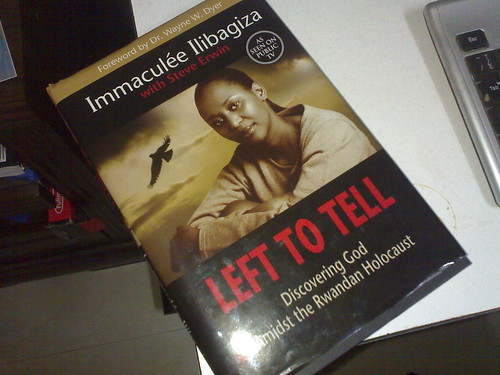
Tears stung my eyes tonight as I listened to the cathartic testimony of Ms. ImmaculĂ©e Ilibagiza, a Rwandan genocide survivor. Ms. Ilibagiza held the Acton University audience spellbound with the harrowing account of her desperate struggle to elude discovery, along with seven other women, for 91 days in the cramped bathroom of a Good Samaritan Hutu pastor. Meanwhile, outside the relative safety of this claustrophobic latrine, machete-wielding death squads butchered a million or more of Ms. Ilibagiza’s Tutsi tribe and family, including her parents and two of her brothers. She described in a poignant and unforgettable way how her fear and terror slowly boiled over into rage, only to grudgingly, and ever so slowly, yield to love and forgiveness through frequent and fervent recitations of the Rosary.

Monday, June 7, 2010

Intermittent Blogging

Ironically, though I have more time to write than during the normal work year, I have been doing less writing of late. I attribute the discrepancy in writing output to time constraints and pressure on the writing end (during school) and quality family time on the leisure end (extended vacation). I will try to be more consistent, but I can't make any promises for the rest of the summer. I will stick to the topics I already mentioned in a previous post when I do find time to write. Thanks for your patience.

Thursday, June 3, 2010

On "Lost"

Plot: Oceanic Flight 815 crashes on an island with mysterious properties. The survivors adapt to their environment with grudging acceptance of their situation, but they never give up hope of returning to their former lives and loved ones.

Conflict: Six seasons of conflict with the “Others,” exiled “Others,” Dharma Initiative folk, and the smoke monster, not to mention one another and themselves from time to time.

Characters: Most redeeming aspect of the show by far. Jack, Sawyer, Kate, Sun and Jin, Hurley, Sayid, Ben, John Locke, Desmond Hume, Richard, Jacob, Charlie and Claire. You really fell in love with these people over the course of half a decade. I cried when many died. It was cathartic. I would be lying if I said otherwise.

Technique: Hybrid frame tale with island as the frame and flashbacks, flashforwards, and sideways [quasi-Purgatory] flashes, of particular characters as the individual short stories.

Allusion: Cultural smorgasbord, a veritable pastiche of religious-philosophical-scientific eclecticism,
postmodern mythology that doesn’t ultimately add up to anything coherent or cogent.

Soundtrack: Evocative in just the right way, at just the right time, in just the right proportion.

Special Effects: J.J. Abrams.

Verdict: Lovable characters played by solid actors made the show enjoyable. Bizarro storyline, however, made for a bait-and-switch mythology that promised so much, yet delivered so little. Note to self: You can’t be all things to all people, or you compromise the integrity of your narrative. Pick something and run with it for God’s sake!

Wednesday, June 2, 2010

On "Rashomon"

Akira Kurosawa’s “Rashomon” (1950) is a cinematic gem. There is a lot to chew on and mull over after watching this film. I could devote this post to the moral ambiguities of mankind symbolized by the motifs of darkness and light or rain and sunshine; however, I might also choose to consider the minimalist approach to set design or the riveting performances of the actors. And before I get lost in the minutiae, I better not forget to mention the avant-garde use of flashback and its consequent philosophical import relative to the characters’ conflicting perceptions of reality. Finally, I would be remiss if I didn’t at least mention the wonderful allegory of the human condition that Kurosawa crafts into this movie.

Monday, May 31, 2010

The Scars of Istanbul Trilogy


The premise of my proposed trilogy is two boys’ tragic loss of identity, family, country, and God and their cathartic reclamation through numerous trials and tribulations. My story is set in sixteenth-century Europe, Africa, and Asia Minor and follows two brothers, the sons of one of Emperor Charles V’s personal bodyguards, who are kidnapped during a coastal raid by Islamic corsairs and sold into bondage in the slave markets of Istanbul. One brother becomes an ambitious janissary, the other a submissive eunuch. Both rise through the ranks of the Ottoman power structure through their unique gifts. Their parallel journeys intersect when they encounter a mysterious woman known only as the Bride. She sets into motion a series of events that will ultimately pit the brothers against one another and will determine the fate of Europe at the Battle of Lepanto.

The tentative titles for the films are as follows:

"The Janissary"
"The Eunuch"
"The Bride"

I hope the trilogy will resemble something close to "300" and "Gladiator" meets "The Mission." I basically want to tell an exciting adventure story with substantive political themes and religious allegory for our own times. I am currently conducting heavy research in preparation for writing the scripts.